DMV Written Test Practice: Complete Study Guide with 100+ Questions
August 18, 202618 min readWritten Test Study Guide
DMV written test practice works best when it helps you understand the rule behind each answer. This guide gives you 105 original study questions, short explanations, a seven-day review plan, and links to official handbook sources so you can prepare for the written or knowledge test used by your state.
Quick answer
Use this page to diagnose weak topics, then verify every rule against your current state driver handbook. Question counts, passing scores, permit restrictions, and test names differ across states, so this is a general dmv written practice test resource—not an official exam and not a replacement for your licensing agency's instructions.
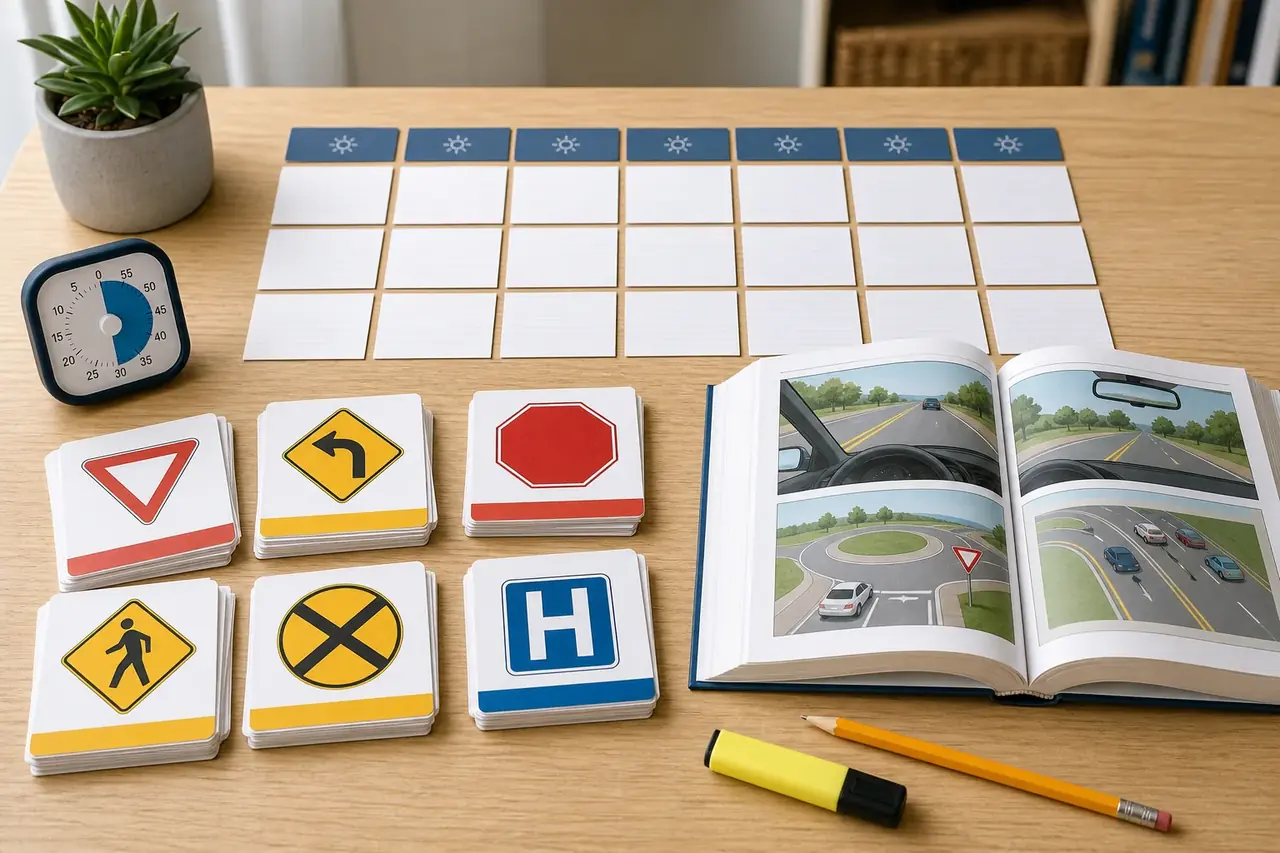
A useful practice session connects handbook reading, question review, and a written explanation of each mistake.
A written test, knowledge test, permit test, or learner test may use different labels, but the tested ideas usually overlap. Expect questions that ask you to identify signs and pavement markings, choose who has the right of way, recognize safe following behavior, respond to emergencies, and apply the licensing rules in your state.
The exact format is local. One state may separate road-sign questions from general knowledge; another may combine everything into one multiple-choice test. The number of questions, passing score, retake policy, language options, online eligibility, and permit restrictions can all change. Use the DMV written-test question-count guide for a comparison, then verify your own state's instructions before booking.
Topic
What to practice
Why it matters
Signs and markings
Shape, color, meaning, lane lines, signals, work zones
Many questions test recognition before the driving scenario begins.
The safest answer is usually the one that prevents a conflict and yields when required.
Safe driving
Following distance, weather, visibility, distractions, impaired driving
These questions test judgment, not just memorized numbers.
State rules
Permit limits, documents, test format, retakes, local restrictions
These details cannot be safely generalized across all states.
How to use this DMV written test practice question bank
Do not rush through 105 questions as if the goal were a single score. Instead, answer each question before opening the explanation, mark the topic when you miss it, and rewrite the rule in your own words. That process makes this dmv written test practice page more useful than an answer-letter drill.
Take a cold pass. Answer 20 questions without checking the notes.
Label the mistake. Use a category such as sign shape, right of way, visibility, or permit rule.
Check the handbook. If your state uses a different rule or number, record the state-specific version.
Repeat later. Revisit missed questions after a break instead of immediately memorizing the answer.
These are original study questions. Sign details can vary slightly in local handbooks, so use your state's official sign chart when a question seems unfamiliar.
1. Which shape is reserved for a stop sign?
Answer: An octagon. The eight-sided shape lets drivers recognize the sign even when the lettering is difficult to see.
2. What does a downward-pointing triangle usually mean?
Answer: Yield. Slow down, look for conflicting traffic or pedestrians, and give priority when another road user has the right of way.
3. What is the usual purpose of a yellow diamond-shaped sign?
Answer: It warns about a condition or hazard ahead, such as a curve, crossing, merging traffic, or changing roadway.
4. What does a railroad crossbuck sign identify?
Answer: A railroad crossing. Treat it like a yield warning, look and listen for trains, and obey any lights, gates, or local instructions.
5. What does a pennant-shaped sign warn you about?
Answer: A no-passing zone. The shape is used as an extra visual cue on the left side of the roadway.
6. What does an orange sign generally indicate?
Answer: Temporary traffic control or a work zone. Slow down, watch for workers, and follow the temporary lane pattern.
7. What type of information is commonly shown on blue signs?
Answer: Motorist services such as fuel, food, lodging, hospitals, or accessible facilities. The exact sign design follows the local handbook.
8. What is the general purpose of a white-and-black regulatory sign?
Answer: It communicates a rule or legal restriction, such as a speed limit, turn restriction, lane-use rule, or parking control.
9. What does a broken yellow center line usually allow?
Answer: Passing may be allowed when it is safe and legal, but the line is not permission to pass without checking sight distance and traffic.
10. What does a solid double-yellow center line generally mean?
Answer: Passing is normally prohibited in both directions. Follow your state's handbook for exceptions such as turns or entering a driveway.
11. What do white lane lines separate?
Answer: Lanes moving in the same direction. A solid white line often signals that changing lanes is discouraged or restricted.
12. Why should you read lane-use arrows before entering an intersection?
Answer: They show which movements are permitted from that lane. Choosing the wrong lane can create a last-second merge or an illegal turn.
13. What should you do when a curb is painted red?
Answer: Treat it as a no-stopping or no-parking restriction unless a local sign says otherwise. Check the local rule before leaving a vehicle there.
14. How should you respond to a flashing red signal?
Answer: Stop completely, then proceed only when the intersection is clear and it is your turn under the applicable right-of-way rule.
15. How should you respond to a flashing yellow signal?
Answer: Slow down and proceed carefully. You do not normally make a full stop unless another sign, signal, or hazard requires one.
16. What should a driver do near a pedestrian crossing sign?
Answer: Reduce speed, scan both sides, and be prepared to stop for pedestrians who are crossing or about to enter the crosswalk.
17. What is the purpose of rumble strips?
Answer: They create vibration and sound to alert a driver who is leaving the lane or approaching a hazard.
18. What do flashing school-bus lights tell approaching drivers?
Answer: Prepare to stop and follow the school-bus stopping rule for your state. Never pass a stopped bus when the law requires a stop.
19. What should you do if a sign is partly blocked by branches?
Answer: Slow down and treat the area as uncertain. Look for a second sign, pavement marking, signal, or official source rather than guessing.
20. If a traffic officer gives an instruction that differs from a sign, which should you follow?
Answer: Follow the lawful direction of the traffic officer. Temporary directions can override the normal signal or sign pattern.
Right of way and intersections: questions 21–40
Most right-of-way questions are really conflict-prevention questions. Do not force your priority; identify who must yield, communicate early, and leave space for a mistake.
21. At a four-way stop, who normally goes first?
Answer: The driver who stopped first. If vehicles stop at the same time, use the tie rule in the next question.
22. Two vehicles stop at the same time at an intersection. Who usually yields?
Answer: The driver on the left usually yields to the driver on the right. Continue only after confirming the other driver is yielding.
23. What must a driver do before making a left turn?
Answer: Yield to oncoming traffic, pedestrians, and any other road user with priority, then turn only when the path is clear.
24. When should a driver stop for a pedestrian at a crosswalk?
Answer: Stop when the pedestrian is crossing or entering the driver's path and the law gives that pedestrian priority. Never pass a stopped vehicle at a crosswalk without checking.
25. Who has priority when entering a roundabout?
Answer: Traffic already circulating normally has priority. Enter only when there is a safe gap and obey signs or lane arrows.
26. What should you do when an emergency vehicle approaches with lights or siren?
Answer: Move safely toward the edge and stop when required, keeping clear of the intersection and allowing the vehicle a path through.
27. At an uncontrolled intersection, what is the safest first step?
Answer: Slow down, look in every direction, and be ready to yield. Do not assume an unmarked intersection belongs to you.
28. Who usually has priority when a vehicle exits a driveway?
Answer: Roadway traffic and pedestrians generally have priority. The exiting driver must stop and enter only when the path is clear.
29. At a T-intersection, which road user must normally yield?
Answer: Traffic coming from the road that ends must yield to traffic on the continuing roadway, unless a sign or signal changes the rule.
30. What should you do if traffic is stopped on the far side of railroad tracks?
Answer: Wait before crossing until there is room to clear the tracks completely. Never stop on the tracks because the light changed.
31. What is the correct approach when your lane is ending?
Answer: Signal, check mirrors and blind spots, adjust speed, and merge into a safe gap without forcing another driver to brake.
32. When should you signal a lane change?
Answer: Signal before moving so other road users have time to understand your intention; then verify the gap instead of relying on the signal alone.
33. What does a center turn lane allow?
Answer: It is generally for preparing or making a left turn, not for passing or long-distance travel. Follow the markings and local rules.
34. What should you check before making a U-turn?
Answer: Check whether U-turns are legal, whether the road is visible in both directions, and whether the maneuver can be completed without interfering with traffic.
35. When is a right turn on red allowed?
Answer: Only after a complete stop and only when no sign prohibits it, the way is clear, and pedestrians and cross traffic are protected.
36. Why should you avoid entering an intersection that you cannot clear?
Answer: You can block cross traffic and create a gridlock conflict even when your signal is green.
37. How should you approach a bicyclist traveling in your lane?
Answer: Slow down, leave the required space, and pass only when you can do so safely and legally. Do not squeeze the rider toward parked cars.
38. What should you do when a school bus is stopped with warning lights?
Answer: Follow your state's school-bus stopping rule and stop when required. Watch for children who may cross unexpectedly.
39. Why should you avoid cutting through a funeral procession?
Answer: It can create a dangerous conflict and may be illegal under local rules. Wait and follow the traffic direction around the procession.
40. What extra caution is needed around a pedestrian using a white cane or guide dog?
Answer: Slow down, yield as required, and never assume the pedestrian sees you. Give extra time and space to cross safely.
Safe driving and vehicle control: questions 41–60
Spaced review is more useful than one late-night burst of memorization.41. What is the purpose of a following-distance rule?
Answer: It creates time to see a hazard, react, and stop. Use a longer gap when visibility, traction, or traffic conditions worsen.
42. What should you do to your following distance in heavy rain?
Answer: Increase it. Wet pavement can extend stopping distance and spray can reduce your view of the road.
43. When should headlights be used in poor visibility?
Answer: Use them whenever visibility is reduced or the law requires them. Low beams are usually the safer choice in fog or heavy precipitation.
44. What is hydroplaning?
Answer: It occurs when tires ride on water instead of maintaining full contact with pavement. Reduce speed and avoid abrupt steering or braking.
45. What should you do if the vehicle begins to skid?
Answer: Ease off the accelerator, look where you want to go, and steer smoothly in the direction needed to regain control.
46. What does anti-lock braking help you do?
Answer: It helps prevent wheel lock during hard braking so you can maintain steering control. Apply firm, steady pressure and follow vehicle instructions.
47. What is a sensible response to a tire blowout?
Answer: Hold the steering wheel firmly, release the accelerator gradually, avoid slamming the brakes, and move to a safe place when control returns.
48. What is the safest response to drowsiness?
Answer: Stop driving and rest. Opening a window or turning up music does not reliably restore alertness.
49. Why is a hands-free phone conversation still distracting?
Answer: The mental distraction remains. A driver can miss signs, pedestrians, or changes in traffic even when both hands are on the wheel.
50. What should you do before moving a vehicle?
Answer: Adjust the seat and mirrors, buckle up, check surroundings, and secure loose items so they do not interfere with control.
51. Why are seat belts important even at low speeds?
Answer: A crash can happen close to home and forces can be serious at ordinary road speeds. Use every available restraint correctly.
52. What should you know about child-restraint rules?
Answer: They are state-specific and often depend on age, height, weight, and seating position. Check the official local rule instead of guessing.
53. What is a blind spot?
Answer: It is an area your mirrors do not fully show. Check mirrors and look over your shoulder before changing lanes.
54. How should mirrors be adjusted?
Answer: Reduce overlap between mirror views while keeping enough side and rear coverage. Mirror checks do not replace a blind-spot glance.
55. Why is speeding risky even when traffic is light?
Answer: Speed reduces reaction time, increases stopping distance, and makes a mistake more severe. The posted limit is not a guarantee that the speed is safe.
56. What is tailgating?
Answer: Following too closely for the conditions. It removes your safety margin and can turn a small brake application into a collision.
57. How should you drive through a work zone?
Answer: Slow down, obey the temporary signs, watch for workers and equipment, and expect lanes or traffic patterns to change.
58. Why is fog especially dangerous?
Answer: It hides hazards and reduces the time available to react. Use appropriate lights, reduce speed, and increase following distance.
59. What should you do on a bridge that may be icy?
Answer: Reduce speed before the bridge, avoid abrupt inputs, and leave extra space because bridges can freeze before nearby pavement.
60. What should you do if a medication may affect driving?
Answer: Read the warning, ask a qualified health professional or pharmacist, and do not drive when the medication makes you drowsy or impaired.
Traffic controls, parking, and emergencies: questions 61–80
These questions combine the rules learners often miss after studying signs: parking position, emergency response, vulnerable road users, and temporary traffic control.
61. What should you do when entering a school zone?
Answer: Follow the reduced speed and time restrictions shown by local signs, scan for children, and be prepared for sudden crossings.
62. Why can work-zone penalties be different from ordinary traffic penalties?
Answer: Many jurisdictions add special protections or enhanced penalties in active work zones. Check the state handbook for the exact rule.
63. What is the first priority during emergency braking?
Answer: Keep the vehicle under control and look for a safe path. Brake firmly as needed without steering into another road user.
64. What should you do if your vehicle becomes disabled in traffic?
Answer: Move out of the travel lane if possible, activate hazard lights, and seek help from a safe position away from traffic.
65. When parking uphill beside a curb, which direction should the front wheels generally point?
Answer: Usually away from the curb so the vehicle rolls toward the curb if it moves. Confirm the exact local rule in your handbook.
66. When parking downhill beside a curb, which direction should the front wheels generally point?
Answer: Usually toward the curb so the vehicle is guided away from moving traffic if it rolls.
67. What is a common wheel position when parking on a hill without a curb?
Answer: Turn the wheels toward the safe edge of the roadway so a rolling vehicle moves away from the travel lane. Check local instructions.
68. What should you do before leaving a parallel-parked vehicle?
Answer: Set the parking brake, place the transmission correctly, check traffic and bicycles, and open the door only when it is safe.
69. How should you study parking distances from hydrants or intersections?
Answer: Learn the exact state or city distances from the official handbook or local code. These numbers are not national constants.
70. What should you do before crossing railroad tracks?
Answer: Look and listen, obey signals and gates, and make sure there is space on the far side before entering.
71. Why should you avoid lingering beside a large truck?
Answer: Trucks have large blind areas and need more room to turn or stop. Pass decisively when safe and avoid cutting in closely.
72. How much space should you give a motorcycle?
Answer: Give the rider a full lane when possible, maintain a safe following distance, and remember that motorcycles can stop or swerve quickly.
73. What should you do before passing a bicyclist?
Answer: Check the lane and oncoming traffic, signal, leave the legally required clearance, and return only when the rider is safely visible.
74. Why should pedestrians be expected near parked cars?
Answer: Parked cars can hide children or adults from view. Slow down and scan the spaces between vehicles.
75. What should you do near an animal-crossing sign?
Answer: Reduce speed and watch the road edges. Animals may move unpredictably or travel in groups.
76. What does a flagger's stop paddle or signal mean?
Answer: Stop and wait for the flagger's direction. Temporary traffic controllers are managing a changing hazard area.
77. What is a safe response to a tow truck or roadside worker on the shoulder?
Answer: Move over when legal and safe, or slow down substantially if you cannot change lanes. Follow the local move-over rule.
78. What should you do before using a disabled parking space?
Answer: Use it only when you have the required permit or plate and meet the local eligibility rules. A temporary need is not enough by itself.
79. Why is the move-over rule important?
Answer: It creates a safety buffer for stopped emergency, service, and maintenance vehicles. Exact lane and speed requirements vary by state.
80. How should cargo be carried?
Answer: Secure it so it cannot shift, fall, block visibility, or create a road hazard. Check state rules for overhangs and required flags or lights.
Permit rules and test strategy: questions 81–100
These are study-process questions rather than promises about a particular DMV's format. Use them to prepare for the judgment-heavy part of a dmv written test.
81. What should be your first study source?
Answer: The current official driver handbook and licensing-agency instructions for your state. Practice sites should reinforce that source, not replace it.
82. Why should practice questions be mixed with handbook reading?
Answer: Questions reveal what you cannot recall, while the handbook explains the complete rule and its exceptions.
83. Why should you choose a state-specific practice test when available?
Answer: Permit restrictions, signs, question formats, and passing rules differ. A state-specific tool reduces the risk of learning a neighboring state's rule by accident.
84. Is there one national passing score for the DMV written test?
Answer: No. Passing scores and any separate sign requirements are set by the state or licensing authority.
85. Is there one national number of written-test questions?
Answer: No. Question counts vary by state, license class, applicant type, and sometimes the testing path.
86. What should you do after missing a practice question?
Answer: Explain the rule, identify the distractor, find the handbook section, and write one short correction. Do not only memorize the letter.
87. How should you study road signs?
Answer: Group them by shape, color, and action, then test yourself with the sign hidden so you recall the meaning instead of recognizing the picture.
88. What is the best approach to a scenario question?
Answer: Identify the hazard, the road user's priority, and the safest legal action before looking at the answer choices.
89. Why should you slow down when a question uses words like “except” or “not”?
Answer: Those words reverse the task. Read the sentence twice and restate what the question is asking in plain language.
90. What should you do when two answer choices seem reasonable?
Answer: Compare them with the handbook and choose the one that is both legal and safest for everyone, not merely the one that saves time.
91. Should you read every answer choice?
Answer: Yes. A familiar-looking first choice may be incomplete, while another choice may include the condition that makes the rule correct.
92. How should you manage time during a written test?
Answer: Read carefully, answer the questions you know, flag uncertain items if the interface allows it, and return with the remaining time.
93. Should you leave a question blank because you are unsure?
Answer: Follow the test's instructions. If unanswered questions count as wrong and review is allowed, make the best supported choice rather than abandoning it.
94. Why is fatigue a study problem?
Answer: Tired learners confuse similar signs and miss qualifying words. Short, focused sessions usually produce better recall than an exhausted marathon.
95. What is spaced practice?
Answer: It is reviewing the same concept across separate sessions with increasing gaps, which helps you recall it later under test pressure.
96. What practice score should make you feel ready?
Answer: Use a consistent personal benchmark such as repeated scores around 85% or higher, but still verify the official state passing standard and weak topics.
97. Why does the handbook edition matter?
Answer: Traffic laws, fees, documents, and test procedures can change. Use the current edition or the latest official online version.
98. Does online testing always remove the need to visit a DMV office?
Answer: No. Eligibility, identity checks, vision screening, documents, and final issuance steps may still require an office visit.
99. Why must permit restrictions be studied separately?
Answer: They can depend on age, license stage, supervising driver, passengers, time of day, and state law; a generic practice test cannot cover every variation.
100. Where should you verify a question about documents, fees, or eligibility?
Answer: Verify it on your official DMV, BMV, MVD, or licensing-agency page. Do not rely on a third-party summary for a final transaction decision.
Bonus review: questions 101–105
Use missed questions as a map: review the rule, not just the answer letter.101. What should you do when a practice answer conflicts with the official handbook?
Answer: Pause, record the conflict, and follow the current official source after checking whether the question is state-specific or outdated.
102. Are practice questions copied from the live DMV exam?
Answer: They should not be presented that way. This guide uses original study questions and does not promise that the live test repeats them.
103. Does a high practice score guarantee a passing result?
Answer: No. It shows readiness on that question set, but the live exam, rules, language, and state requirements may differ.
104. Why do agencies use different names for the same type of test?
Answer: States may call it a written test, knowledge test, permit test, learner test, or driver license test even when the purpose is similar.
105. What is the best task for the day before the test?
Answer: Review your error log, signs, state-specific instructions, documents, and appointment details, then sleep instead of starting a new giant topic.
A seven-day DMV written test study plan
A short schedule is easier to follow than a vague promise to “study more.” Adjust the time to your needs, but keep the order: learn the local source, practice, review mistakes, and retest.
Day
Focus
Work to complete
1
Official source
Open your state handbook, note the test name, passing standard, documents, and permit restrictions.
2
Signs
Review shape and color groups, then complete questions 1–20 without notes.
3
Right of way
Study intersections, turns, crosswalks, roundabouts, and emergency vehicles; complete questions 21–40.
Retest missed categories, reread official sections, and confirm appointment and document details.
Keep an error log with three columns: “what I chose,” “the correct rule,” and “where the handbook confirms it.” If you repeatedly miss signs, use the traffic signs and road rules guide. If your question is specific to New Jersey, use the NJ written-test questions guide instead of applying a general rule blindly.
Official sources and state-specific checks
Use third-party practice questions for repetition, but use official sources for requirements, legal wording, eligibility, fees, documents, and the final test format. These links are starting points; select your state before making a transaction decision.
Texas Driver Handbooks — another official handbook source with state-specific instructions.
This page is independent study content. It is not issued by a DMV, BMV, MVD, or other licensing agency. Official sources control if a practice explanation and a current handbook differ.
FAQ: DMV written test practice
They are useful for learning concepts and finding weak areas, but they are not a promise of the live exam. Verify current rules and wording in your state's official driver handbook.
The number of questions and passing score vary by state and applicant type. Check the official DMV, BMV, MVD, or licensing-agency instructions for your test.
No. Combine practice questions with the current official handbook, review every missed answer, and use your state's own testing instructions as the final authority.
Start with traffic signs, right-of-way, safe following distance, lane changes, impaired or distracted driving rules, and the permit restrictions that apply in your state.
Treat the current official handbook and licensing-agency instructions as the source of truth, record the conflict, and do not memorize the practice answer until it is resolved.
Bottom line
A strong dmv written test practice routine is not just a large pile of questions. It is a loop: read the official source, answer a focused set, explain every mistake, and repeat the weak category until the rule is clear. Start with the 105 questions above, then use a state-specific practice test before you schedule the real exam.
Updated August 18, 2026. Practice content is original and educational; state agencies and current official handbooks control the final rule, test format, eligibility, and documents.