What to Bring to the DMV for Permit Test: Documents Checklist
For most DMV permit test appointments, bring proof of identity, proof of residency, Social Security proof when required, your completed application, payment, appointment confirmation, and any minor or driver education forms your state requires. If you wear glasses or contacts for driving, bring them too because a vision screening may be part of the visit.
This checklist gives you a safe national starting point, then shows where state rules can change. Use it with your official DMV appointment page before you leave home. If you still need to book the correct service type, read the DMV permit test appointment guide first. If you are still preparing for the knowledge exam itself, start with our DMV permit practice test and final-review DMV cheat sheet.
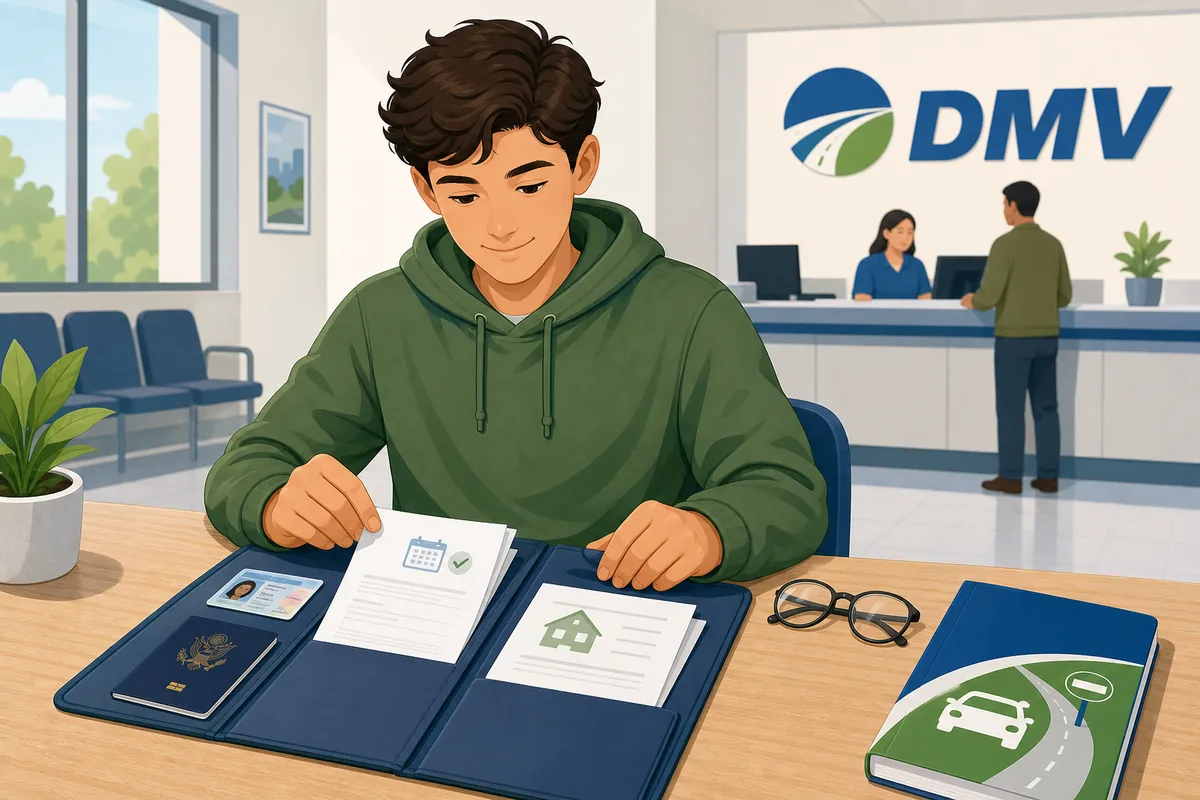
Quick Checklist
Bring identity proof, birth or lawful-presence proof, residency proof, Social Security proof if required, completed forms, parent or guardian consent if you are a minor, driver education proof if your state requires it, payment, appointment confirmation, and corrective lenses if you use them.
DMV Permit Test Documents Checklist
The safest way to prepare is to build a folder with every document your state lists, then add a few practical appointment items. The table below explains what each item proves and when it usually matters.
| What to Bring | Why It Matters | Common Examples | Check Before You Go |
|---|---|---|---|
| Proof of identity | Shows the DMV who you are before issuing a learner permit. | Passport, birth certificate, state ID, permanent resident card, or other DMV-approved identity document. | Confirm whether originals or certified copies are required. |
| Date of birth or lawful presence | Verifies age eligibility and legal presence rules. | Certified birth certificate, passport, immigration document, or state-approved legal presence proof. | Name mismatches may require marriage, court, or name-change records. |
| Social Security proof | Some states verify Social Security number or ineligibility before licensing. | Social Security card, W-2, pay stub, or acceptable state alternative. | Rules vary, especially for non-citizens and applicants without an SSN. |
| Proof of residency | Confirms you live in the state where you are applying. | Utility bill, bank statement, school record, lease, insurance bill, or parent residency document for minors. | Many states require two proofs and may limit document age. |
| Application and signatures | Starts the learner permit transaction and confirms applicant information. | Online confirmation, paper application, parent signature, guardian consent, or school certification. | Minors should check whether a parent must appear in person. |
| Payment | Covers application, testing, permit, or photo fees. | Card, cash, check, money order, or online receipt depending on the DMV office. | Some offices limit payment types or charge separate retest fees. |
| Appointment proof | Helps check-in and prevents confusion at busy offices. | Printed confirmation, email, QR code, confirmation number, or online account screen. | Confirm office location, arrival time, cancellation rules, and whether walk-ins are accepted. |
| Glasses or contacts | Many permit visits include a vision screening. | Your normal corrective lenses for driving. | If you need lenses to pass vision screening, your license may carry a restriction. |
Why State Rules Change the Checklist
There is no single national DMV document rule. One state may ask for two residency proofs, another may route you through a REAL ID document checklist, and another may let you start online but still require identity review in person. Even the agency name changes: DMV, BMV, MVD, DPS, RMV, MVC, or Department of Revenue.
Use national advice only as a preparation framework. Your official state page controls the real appointment. For example, California separates instruction permit application steps from knowledge testing, New York tells applicants to prepare documents before completing the permit transaction, and Virginia explains knowledge testing as part of a larger license or permit process.
What Minors Usually Need for a Learner Permit
If you are under 18, your checklist is usually longer than an adult applicant's checklist. Many states require parent or guardian consent, school attendance proof, driver education completion, or supervised driving acknowledgments. Some states also require the parent to sign in front of DMV staff or submit a specific form.
Teen applicants should not rely on a friend or older sibling's memory. Check the minor permit page for your state and bring every signed form. If a parent cannot attend, confirm whether a notarized consent form is accepted before your appointment.
Minor Applicant Warning
A missing parent signature or driver education record can stop the permit transaction even if you are ready for the written test. Verify minor forms before the appointment, not at the counter.
REAL ID vs Standard Permit Documents
Some learners use the permit appointment to start a REAL ID-compliant license path, while others apply for a standard credential. REAL ID document lists are often stricter because the DMV must verify identity, lawful presence, Social Security number, and state residency using approved documents.
If your state gives you a choice, decide before the appointment. A standard permit may have a different document pathway than a REAL ID permit or license. If you bring only partial documents, the office may let you complete a standard transaction but not the REAL ID version you wanted.
What Happens on Permit Test Day
A permit test visit usually has several steps, and the written test may not be first. You may check in, present documents, complete or confirm the application, pay fees, complete a vision screening, take a photo, then take the knowledge exam or receive instructions for an online test path.
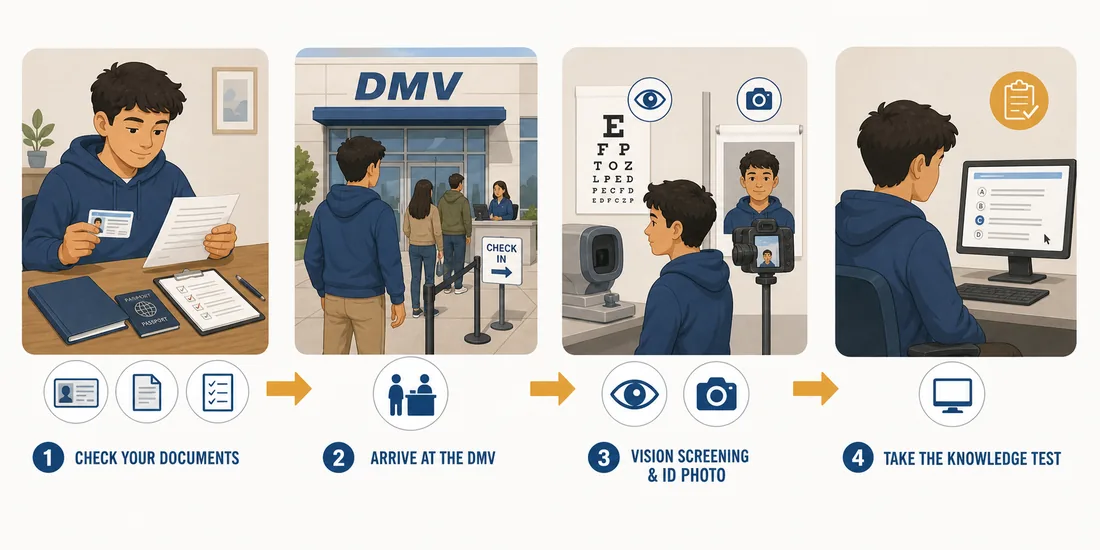
Arrive with enough time to park, find the correct office area, and fix small issues such as a missing confirmation number. If your DMV offers online check-in, use it. If the test is taken on a kiosk or computer, ask staff what happens if the system closes, freezes, or you need accessibility support.
What Not to Bring or Rely On
Do not bring only photocopies unless your DMV specifically allows them. Do not rely on a school ID, expired document, screenshot, or unofficial mail if your state requires original proof. Do not assume your phone battery will last long enough to show appointment confirmation, digital payment, or document references.
Also avoid bringing study notes into the testing area unless staff clearly permit them before the exam starts. A cheat sheet can help before check-in, but test rules usually prohibit notes, phones, or outside help during the knowledge exam.
If You Are Missing a Document
If you notice a missing document before the appointment, check whether you can reschedule without a fee or switch to a later date. Showing up with incomplete proof may waste the appointment and still require a second visit. For high-stakes documents like birth certificates, immigration papers, Social Security proof, and court name-change records, solve the document issue first.
If your name has changed, bring the linking document that explains the change. If your residency proof is in a parent or guardian's name, check whether your state needs a residency certification form, parent proof, or additional school record.
State Examples to Verify
Use these examples to understand the type of official page you should check, not as a substitute for your own state's current requirement.
| State Example | What the Official Page Helps Confirm | Why It Matters |
|---|---|---|
| California | Instruction permit application steps, knowledge test, application, fees, and identity documents. | Applicants often need to connect document preparation with the online application and test option. |
| New York | Permit test path, document review, proof requirements, and office transaction steps. | Online testing may still require identity-document review before the permit transaction is complete. |
| Virginia | Knowledge exam rules, identity and residency requirements, and test structure. | Document readiness and test rules are separate checks; both must be handled. |
| Texas | DPS appointment, learner license, driver education, identity, residency, and fee requirements. | Teen and adult paths can differ, especially around driver education and appointment steps. |
How to Prepare the Night Before
- Open your official DMV checklist. Match each required document against your folder.
- Check names and addresses. Look for spelling differences, old addresses, or missing middle names.
- Print or save appointment proof. Keep a paper backup if possible.
- Charge your phone. You may need email, maps, payment, or appointment details.
- Review weak test topics only. Use the DMV road signs test for signs or the 40 question DMV practice test for a final mixed review.
- Plan transportation. A permit applicant usually cannot drive to the appointment alone.
Official Sources to Check
Use official DMV pages when a document rule could affect your appointment. Start with your own state's DMV site or the USA.gov state motor vehicle agency directory. Helpful examples include the California DMV instruction permits page, New York DMV's learner permit page, the Virginia DMV knowledge exam page, Texas DPS driver license application guidance, and your state's current driver handbook.
FAQ
Bottom Line
Knowing what to bring to the DMV for permit test day is part of passing. Study the rules, but also prepare the paperwork that lets you sit for the exam. Build your document folder from your official state checklist, confirm minor and REAL ID requirements, bring payment and appointment proof, and keep your glasses or contacts with you if you use them for driving.