DMV Cheat Sheet 2026: Permit Test Study Guide & Last-Minute Review
A DMV cheat sheet works best when it helps you organize the rules that appear again and again on the permit test: road signs, right-of-way, speed, parking, alcohol rules, safe driving choices, and permit restrictions. It should not be a promise that you can skip your state driver handbook.
Use this guide as a practical DMV written test cheat sheet and final review plan. If you need active practice instead of notes, start with our DMV permit practice test, then confirm readiness with the 40 question DMV practice test.
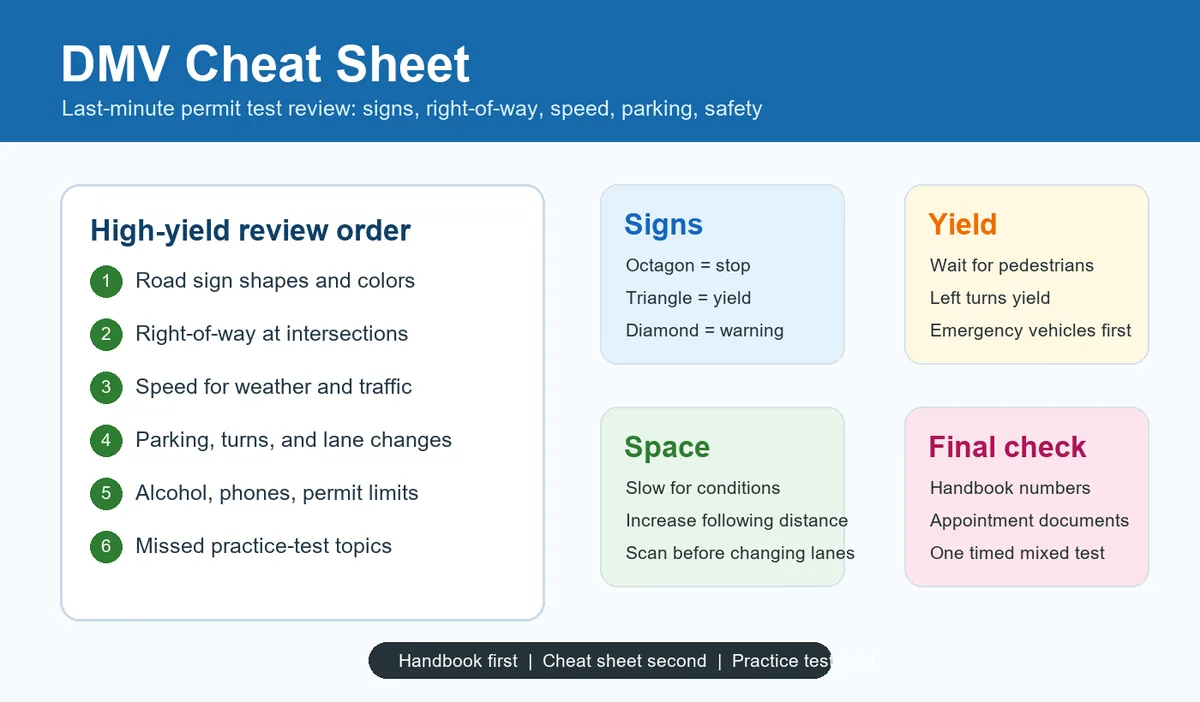
Quick Answer: What Should You Put on a DMV Cheat Sheet?
Put the highest-yield rules on one page: sign shapes and colors, right-of-way order, stopping rules, lane changes, passing, parking, safe speed for conditions, following distance, alcohol and drug limits, phone restrictions, school buses, emergency vehicles, and permit restrictions. Then add a small section for mistakes from your latest practice test.
The best DMV cheat sheet 2026 is not a list of random answers. Real tests can change wording, answer order, and examples. Your sheet should help you recognize the rule behind the question, so you can answer even when the sentence looks different from a practice quiz.
Use It the Right Way
A cheat sheet is for review after you have studied. Your official state driver handbook remains the source of truth for exact local rules, documents, fees, appointment steps, and passing scores.
DMV Cheat Sheet Topic Map
Use this table as the backbone of your review. If a row feels weak, study that handbook section before taking another full practice test.
| Topic | What to Memorize | How It Appears on the Test | Best Practice Page |
|---|---|---|---|
| Road signs | Shapes, colors, warning signs, regulatory signs, guide signs, signals, pavement markings | Meaning, required driver action, and sign recognition from partial clues | DMV road signs test |
| Right-of-way | Four-way stops, left turns, pedestrians, emergency vehicles, uncontrolled intersections | Scenario questions asking who should go, wait, stop, or yield | Class C practice test |
| Speed and space | Speed for conditions, following distance, curves, rain, fog, school zones, work zones | Questions where the legal answer is slower or more cautious than the posted limit | 40 question DMV practice test |
| Parking and turns | Curb parking, hill parking, turn signals, backing, lane position, no-parking zones | Situations involving distance, direction, wheels, signs, or visibility | Sample written test guide |
| Alcohol and distractions | BAC rules, implied consent, open container rules, phone use, penalties, underage restrictions | Fact-heavy questions where state details matter | State-specific guide |
Road Signs Cheat Sheet: Shapes, Colors, and Meanings
Road signs are ideal for cheat-sheet review because the test often gives you a fast-recognition clue. The Federal Highway Administration's Manual on Uniform Traffic Control Devices explains national traffic-control standards, but your state handbook decides which signs and examples are emphasized on your exam.
Sign Shapes You Should Know Cold
- Octagon: stop completely, even if the intersection looks clear.
- Triangle: yield to traffic or pedestrians before entering.
- Diamond: warning, such as curve, merge, pedestrian, animal crossing, or slippery road.
- Pennant: no passing zone on the left side of the road.
- Round sign: railroad crossing warning.
- Rectangle: regulation, lane use, speed limit, or guide information depending on color.
Sign Colors That Save Time
Red usually means stop, yield, do not enter, or wrong way. Yellow warns you about conditions ahead. Orange marks work zones. White signs often state legal rules. Green guides direction or distance. Blue points to services, and brown points to recreational or cultural areas.
If you miss sign questions, do not keep retaking the same mixed quiz. Spend 10 minutes on a focused road signs practice test, then return to mixed DMV questions after your sign score stabilizes.
Right-of-Way Rules to Review Before the Permit Test
Right-of-way questions are tricky because the safest action is often to wait. The test is checking whether you can prevent conflict, not whether you can move first. Add these rules to your DMV permit test cheat sheet:
- Pedestrians come first in crosswalk situations. Slow down, stop when required, and do not pass a stopped vehicle at a crosswalk.
- Emergency vehicles need a clear path. Pull over when safe and follow your state rules for stopped emergency vehicles.
- At a four-way stop, arrival order matters. If two vehicles arrive at the same time, the driver on the right usually goes first.
- Left turns yield to oncoming traffic. Wait until the turn can be completed safely.
- Do not assume another driver will yield. Defensive driving questions often reward the answer that reduces risk.
Speed, Space, and Safe Driving Rules
Many learners memorize speed limits but miss questions about conditions. The correct answer may be to slow down even when the posted limit is higher. Add reminders for rain, fog, curves, traffic, school zones, work zones, and limited visibility.
Following distance also matters. Leave more space behind motorcycles, large trucks, emergency vehicles, and any vehicle with blocked visibility. When the test asks what to do in bad weather or heavy traffic, the safest answer usually includes slowing down, increasing following distance, and avoiding sudden movements.
Parking, Turns, and Lane Changes
Parking and lane questions often feel small, but they reveal whether you understand controlled vehicle movement. Review curb colors, no-parking signs, disabled parking, fire hydrants, crosswalks, driveways, intersections, railroad tracks, and hill parking rules from your state handbook.
For lane changes, remember the sequence: signal, check mirrors, check blind spots, confirm a safe gap, move smoothly, and cancel the signal. On turn questions, watch for required lanes, pedestrian conflicts, bike lanes, and signs that limit turns.
Alcohol, Phones, and Permit Restrictions
This is the section where state-specific details matter most. A general DMV practice test cheat sheet PDF may mention common BAC limits or phone rules, but your actual exam may ask about local penalties, underage rules, implied consent, or graduated driver licensing restrictions. Confirm these numbers in your state handbook.
For example, the California DMV provides a current Driver's Handbooks page with handbook formats and sample test resources, while the New York DMV's Driver's Manual and Practice Tests page explains which manual chapters cover written-test material. Use official sources like these whenever a number or legal rule could change.
How to Build Your Own DMV Cheat Sheet PDF
If you want a printable sheet, make it personal. A generic PDF may cover common facts, but your missed questions show exactly where your score is leaking. Use this five-step process:
- Take one mixed practice test first. Use the score as a diagnostic, not a final verdict.
- Sort missed answers by category. Create buckets such as signs, right-of-way, speed, parking, alcohol, and permit restrictions.
- Write the rule, not the answer letter. Example: "At a four-way stop, first arrival goes first; tie goes to the driver on the right."
- Add one state-specific note per weak topic. Pull the exact number or restriction from your official handbook.
- Retest with a different format. If your score improves on unfamiliar wording, the sheet is working.
Last-Minute DMV Test Review Plan
The night before your test is for organizing, not cramming hundreds of new questions. Before you start the final study block, make sure your appointment folder matches the DMV permit test documents checklist so paperwork does not stop you from testing. Use this short plan if your exam is close:
| Time | Review Task | Goal |
|---|---|---|
| 20 minutes | Review sign shapes, colors, and the signs you missed most often | Fast recognition without guessing |
| 20 minutes | Review right-of-way and intersection scenarios | Know when to stop, yield, wait, or proceed |
| 15 minutes | Review speed, following distance, parking, and lane rules | Catch small rule details that cause avoidable misses |
| 15 minutes | Check state-specific restrictions and appointment documents | Avoid surprises at the DMV office |
| 25-35 minutes | Take one mixed timed test | Confirm readiness under realistic pressure |
What Not to Put on a DMV Cheat Sheet
A cheat sheet should be short enough to use. Do not fill it with full handbook paragraphs, every practice question you have ever seen, random online answer keys, or state rules that do not apply to you. Avoid any page that claims to reveal the exact live DMV test. Real exam banks are controlled by licensing agencies, and memorizing leaked-looking answers can leave you unprepared when wording changes.
Also avoid mixing commercial driver license, motorcycle, and standard passenger-vehicle rules unless your exam actually includes those topics. Most learners using this page are preparing for a regular permit, written test, or Class C license test.
FAQ
Next Step: Turn the Cheat Sheet Into Practice
A cheat sheet helps you review quickly, but your score improves when you test the rules under pressure. Start with a focused topic, fix missed answers, then take a mixed test. If you are preparing for your first permit, use the DMV permit practice test. If you want a longer readiness check, take the 40 question DMV practice test.
Study Path Summary
Handbook first, cheat sheet second, practice test third, missed-answer review fourth. That sequence is more reliable than memorizing answer keys and hoping the real DMV test uses the same wording.