New Jersey DMV Written Test Questions and Answers: 2026 Study Guide
If you are searching for DMV NJ written test questions and answers, start with the state-specific rules instead of memorizing a generic answer bank. The New Jersey knowledge test is commonly described as a 50-question exam with an 80% passing target, so you should be ready for at least 40 correct answers and for questions that test judgment, not just sign names.
This guide gives you original New Jersey-style practice questions, short answer explanations, a topic checklist, and the official MVC resources to verify before you schedule. The questions below are study examples, not live MVC questions.
Use the official handbook as the source of truth
Practice answers help you find weak areas. For current rules, documents, test scheduling, and eligibility, check the NJ MVC knowledge-test instructions and the official first-license page with driver manuals.

Quick Answer: What Should You Expect on the NJ Written Test?
The New Jersey written or knowledge test checks whether you understand the rules needed to drive safely before moving to the next licensing step. The exact appointment path depends on your applicant type, but your preparation should cover the state manual, traffic control, safe driving decisions, and licensing requirements.
| Study fact | Practical meaning | How to prepare |
|---|---|---|
| 50 questions | Plan for a broad mixed review rather than one narrow topic. | Rotate signs, signals, right-of-way, safe driving, and licensing rules. |
| 80% target | Forty correct answers out of 50 is a useful readiness benchmark. | Do not book the exam after one lucky score; repeat unfamiliar mixed questions. |
| State-specific rules | Generic DMV questions may omit New Jersey wording and procedures. | Read the NJ manual and verify current MVC instructions before test day. |
High-Value New Jersey Knowledge-Test Topics
Use this checklist to organize your review. When you miss a question, record the topic and the rule—not only the correct letter.
| Topic | What to review | Common mistake |
|---|---|---|
| Signs and signals | Shape, color, signal meaning, stop/yield actions, and pavement markings. | Recognizing a sign but missing the action it requires. |
| Right-of-way | Four-way stops, turns, pedestrians, bicycles, school buses, and emergency vehicles. | Assuming the biggest or fastest vehicle automatically goes first. |
| Space and speed | Following distance, weather, visibility, curves, lane changes, and safe speed choice. | Treating the posted limit as a required speed in every condition. |
| Sharing the road | Motorcycles, trucks, pedestrians, cyclists, work zones, and disabled vehicles. | Looking only at the lane ahead and missing vulnerable road users. |
| Licensing rules | Permit steps, identification, supervised driving, restrictions, and MVC procedures. | Using an old checklist without confirming the current state process. |
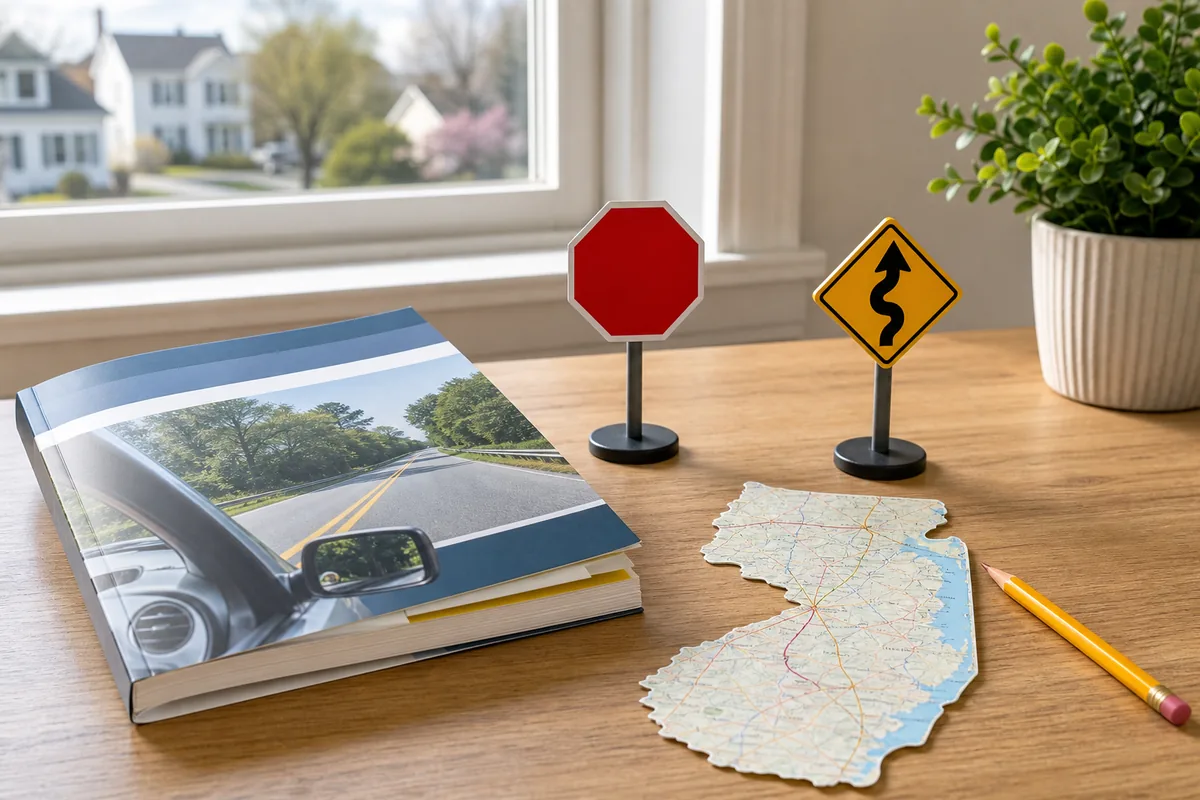
DMV NJ Written Test Questions and Answers
These original practice questions are designed to make you explain the rule behind the answer. They are not official exam questions and should be checked against the current NJ MVC manual.
How to Turn Missed Answers into a Study Plan
- Group misses by topic. Separate signs, right-of-way, speed and space, sharing the road, and licensing procedures.
- Read the matching handbook section. Do not rely on an answer explanation when the rule may have changed.
- Practice the weak category, then return to mixed questions. Category drills build understanding; mixed tests show whether you can recognize the rule in a new situation.
- Use a readiness benchmark. Aim for at least 40 out of 50 on unfamiliar practice questions, then keep reviewing until the score is stable.
What to Check Before Booking an NJ Knowledge Test
Passing practice questions is only one part of the process. Before you make an appointment, use the official MVC instructions to confirm the service type, identification and address documents, examination-permit steps, fees, vision requirements, and any age-specific rules that apply to you.
- Read the current New Jersey Driver Manual, linked from the official first-license page, including the sections that match your applicant type.
- Review the NJ MVC first-license process before selecting an appointment.
- Use the official knowledge-test page for current testing instructions and agency requirements.
- Use the official sample knowledge test as a source check, not as a promise that the live test repeats the same questions.
FAQ: DMV NJ Written Test Questions and Answers
Final Recommendation
The most reliable way to prepare for the New Jersey written test is to combine the official manual with original practice questions and answer explanations. Use the 50-question format and 40-correct benchmark as a study target, but keep checking the current MVC instructions for the real appointment and licensing process.
If you want more general mixed practice after this guide, use the DMV permit practice test. If signs are your weak area, switch to the DMV road signs test, then return to unfamiliar NJ-style questions.
Sources and scope
This page uses the official NJ MVC knowledge-test instructions, driver-manual index, first-license guidance, and sample knowledge-test materials as verification points. The practice questions and explanations are original study content and are not official MVC questions.