DMV Permit Test Questions and Answers: 50 Common Questions
August 22, 202618 min readPermit Test Question Bank
DMV permit test questions are easier to remember when you learn the traffic rule behind each answer. This guide gives you 50 original questions with short explanations covering signs, right-of-way, safe driving, parking, emergencies, and permit-test strategy.
Quick answer
Use these questions as a review set, not as a promise that the live exam will use the same wording. Question counts, passing scores, permit restrictions, and exceptions vary by state. Check your current official driver handbook before you schedule or take the test.
The most useful practice session combines question review, handbook checking, and an explanation of every missed answer.
Answer each question before opening the explanation. When you miss one, write down the topic rather than only the question number. A useful error label might be “sign shape,” “right-of-way,” “wet weather,” “parking,” or “state-specific permit rule.”
Take a cold pass. Answer 10 questions without checking notes.
Explain the rule. Say why the answer is safest or legally required.
Check your handbook. Confirm local numbers, exceptions, and permit restrictions.
This question bank supports the site's broader DMV written test practice guide, but it has a narrower job: give you a compact set of permit-focused questions and explanations.
Questions 1–10: signs and pavement markings
Sign questions reward recognition of shape, color, and placement. If a local handbook uses a special exception, follow that handbook.
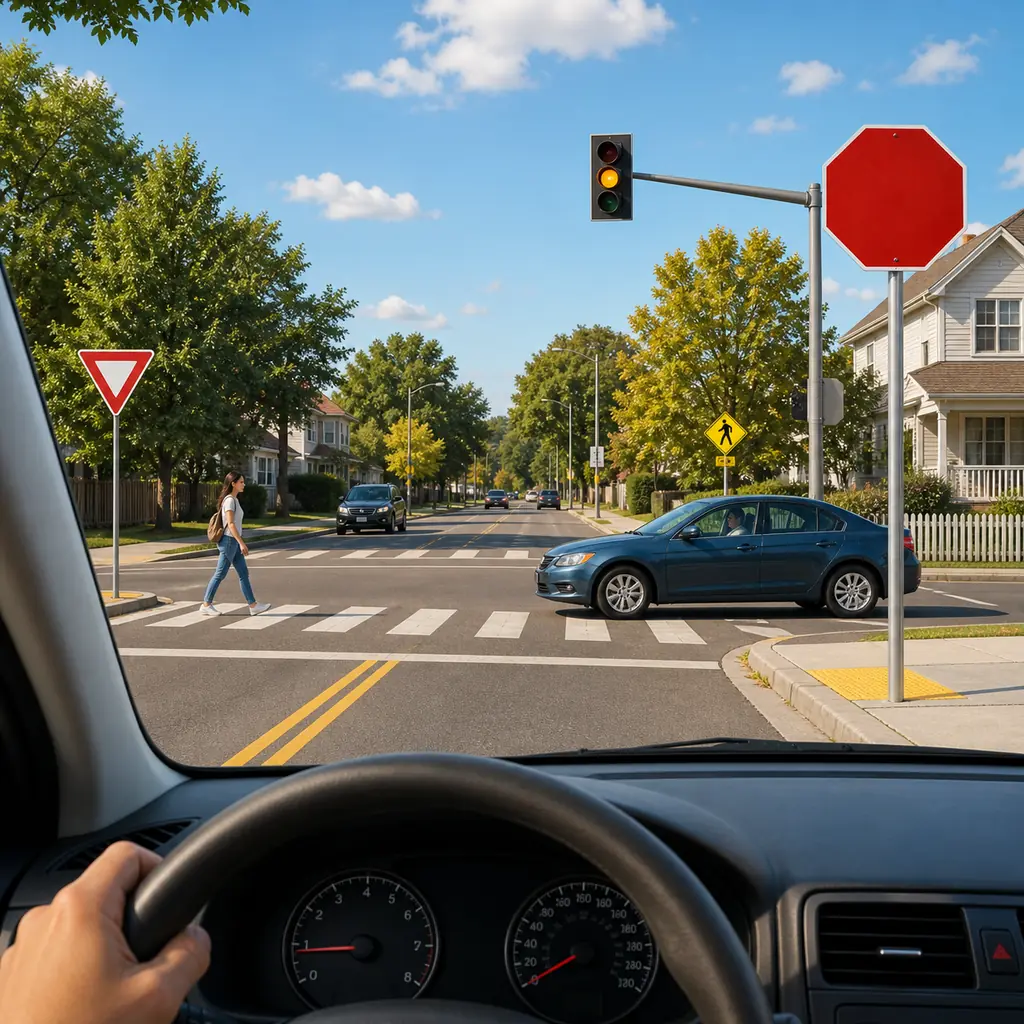
Read the full traffic scene: the sign, signal, lane marking, and people around the vehicle all matter.1. Which shape is reserved for a stop sign?
Answer: An octagon. The eight-sided shape helps drivers recognize the instruction even when the lettering is difficult to see.
2. What does a downward-pointing triangle usually mean?
Answer: Yield. Slow down, scan for traffic and pedestrians, and give priority when another road user has the right of way.
3. What is the usual purpose of a yellow diamond-shaped sign?
Answer: It warns about a condition or hazard ahead, such as a curve, crossing, merging traffic, or changing roadway.
4. What does an orange road sign generally indicate?
Answer: Temporary traffic control or a work zone. Slow down, watch for workers, and follow the temporary lane pattern.
5. What is the general purpose of a white-and-black regulatory sign?
Answer: It communicates a rule or legal restriction, such as a speed limit, turn restriction, lane-use rule, or parking control.
6. What does a pennant-shaped sign warn you about?
Answer: A no-passing zone. Its special shape provides an additional visual cue, usually on the left side of the roadway.
7. What does a broken yellow center line usually allow?
Answer: Passing may be allowed when it is safe and legal. The line is not permission to pass when sight distance, traffic, or a sign makes the maneuver unsafe.
8. What does a solid double-yellow center line generally mean?
Answer: Passing is normally prohibited in both directions. Follow your state's handbook for exceptions such as a legal turn into a driveway.
9. How should you respond to a flashing red signal?
Answer: Stop completely, then proceed only when the intersection is clear and it is your turn under the applicable right-of-way rule.
10. What should you do near a pedestrian crossing sign?
Answer: Reduce speed, scan both sides, and be prepared to stop for pedestrians who are crossing or about to enter the crosswalk.
Questions 11–20: right-of-way and intersections
Many permit test questions describe a conflict between road users. The safe answer usually begins with slowing, yielding, stopping, or waiting for a clear path.
11. At a four-way stop, who normally goes first?
Answer: The driver who stopped first normally proceeds first. If vehicles stop at about the same time, the driver on the left yields to the driver on the right.
12. What should you do when you arrive at the same time as another vehicle?
Answer: Yield to the vehicle on your right at an uncontrolled or all-way-stop intersection, unless signs, signals, or a local rule direct otherwise.
13. Who must usually yield when making a left turn?
Answer: The left-turning driver generally yields to oncoming traffic and pedestrians crossing the turn path. A green light does not erase the duty to check for conflicts.
14. When must a driver yield to a pedestrian?
Answer: Yield when a pedestrian is in a crosswalk or has entered the driver's path under the applicable state rule. Slow before the crosswalk so a stop is possible.
15. What should you do when an emergency vehicle approaches with warning signals?
Answer: Safely move to the side and stop when required, keeping intersections and the emergency vehicle's path clear. The exact procedure can vary by state and road layout.
16. How should you enter a roundabout?
Answer: Slow down, yield to traffic already circulating, enter when a safe gap appears, and follow lane markings until your exit.
17. What is the safest response to a stopped school bus with warning lights?
Answer: Stop and remain stopped when the law requires it. Do not pass a stopped school bus simply because the road looks clear; check the state rule for divided highways and exceptions.
18. What is the correct sequence for a lane change?
Answer: Check mirrors, signal, check the blind spot, confirm a safe gap, move smoothly, and cancel the signal. A signal communicates intent but does not create the right of way.
19. What should you do at an intersection with no signs or signals?
Answer: Reduce speed, scan for traffic and pedestrians, and apply the right-of-way rule that fits the situation. Treat uncertainty as a reason to wait, not to accelerate.
20. What should you do when entering a highway from an acceleration lane?
Answer: Match traffic speed when possible, check mirrors and blind spots, signal, and merge only when a safe gap exists. Entering traffic must not force another driver to brake suddenly.
Questions 21–30: safe driving and vehicle control
These DMV permit test questions test judgment more than memorized numbers. When weather, visibility, traffic, or vehicle condition changes, your following space and speed should change too.
21. Why should you leave extra following distance?
Answer: More space gives you more time to see a hazard, react, and stop smoothly. Use additional space behind motorcycles, trucks, buses, and vehicles that may block your view.
22. What should you do when roads become wet?
Answer: Slow down, increase following distance, use smooth steering and braking, and watch for standing water. The posted speed limit is not a guarantee that the same speed is safe in rain.
23. How should you drive in fog?
Answer: Reduce speed, increase space, use the lights allowed by your state, and avoid high beams when they reflect glare back at you. If visibility becomes unsafe, find a legal safe place to stop.
24. What should you do if the vehicle begins to hydroplane?
Answer: Ease off the accelerator, keep the steering steady, and avoid sudden braking or sharp steering until the tires regain contact. Look and steer toward the intended path.
25. Why is phone use a common permit-test topic?
Answer: It diverts visual, manual, and mental attention. Follow your state's hands-free and novice-driver restrictions, and do not use a phone when it prevents you from controlling the vehicle.
26. What is the safest rule for alcohol or impairing substances?
Answer: Do not drive impaired. A person's judgment and reaction can be affected before they feel obviously intoxicated, and novice-driver rules may be stricter than general adult limits.
27. Why should you give motorcycles extra space?
Answer: Motorcycles are smaller and can be harder to see, while road hazards and wind affect them more quickly. Do not crowd, cut off, or share a lane with a motorcycle where prohibited.
28. What should you do after a tire blowout?
Answer: Hold the steering wheel firmly, ease off the accelerator, avoid slamming the brakes, and move to a safe location once the vehicle is under control.
29. What is the best first response to a skid?
Answer: Stay calm, look toward the open path, ease off the accelerator, and steer smoothly in the direction needed to regain control. Avoid abrupt inputs that can worsen the skid.
30. What should you do if you feel too tired to drive?
Answer: Stop driving and rest or arrange another safe way to travel. Opening a window or turning up music is not a dependable substitute for sleep.
Questions 31–40: parking, emergencies, and vehicle control
Parking and emergency questions often include a curb, driveway, railroad track, or roadside worker. Read every location detail before choosing an answer.
31. Which way should the wheels point when parking uphill next to a curb?
Answer: In many states, the wheels turn away from the curb so the vehicle rolls toward the curb if it moves. Follow the exact diagram in your state handbook.
32. Which way should the wheels point when parking downhill next to a curb?
Answer: In many states, the wheels turn toward the curb. The goal is to keep a rolling vehicle from moving into traffic; confirm the local rule and slope instructions.
33. What does a red-painted curb usually communicate?
Answer: A no-stopping or no-parking restriction, unless a local sign or rule says otherwise. Curb colors are local details worth checking in the handbook.
34. Why should you avoid stopping across a crosswalk or driveway?
Answer: It blocks pedestrians, wheelchair users, or vehicles entering and leaving. A clear path is part of safe and lawful stopping, even when traffic is slow.
35. What should you do at a railroad crossing?
Answer: Slow, look and listen, obey lights and gates, and never stop on the tracks. If traffic is backed up, wait before crossing until you can clear the tracks completely.
36. Can you use a disabled parking space for a quick stop?
Answer: No, not unless you are authorized and meet the local requirements. Short duration does not remove the restriction.
37. What should you do if your vehicle stalls in traffic?
Answer: Turn on hazard lights when appropriate, move out of the travel lane if possible, and call for help from a safe position. Do not stand in a live lane to inspect the vehicle.
38. What is the first priority after a collision?
Answer: Protect people from additional danger, check for injuries, and call emergency services when needed. Move vehicles only when safe and when the law or emergency responders permit it.
39. What does a move-over rule generally protect?
Answer: Emergency responders, tow operators, maintenance workers, and stopped vehicles on the roadside. Move over when safe or slow down as required by your state.
40. What should you do if the accelerator sticks?
Answer: Keep control, shift to neutral if appropriate for the vehicle, brake firmly, and move to a safe location. Once stopped, turn off the engine if it can be done safely and request assistance.
Track the topic behind a missed answer so your next study session is targeted instead of repetitive.
Questions 41–50: permit rules and test strategy
The last group explains how to use practice material responsibly. Generic questions cannot replace the current rules for your state, age, license class, or test method.
41. Which source should settle a conflict between a practice answer and a local rule?
Answer: Your current official driver handbook and licensing-agency instructions. Record the conflict and do not memorize a generic answer until the local rule is clear.
42. Why can two states give different answers to a similar permit question?
Answer: States set their own testing procedures, permit restrictions, traffic laws, and exceptions. A general study question may teach the concept, but the local handbook controls the exact number or rule.
43. How should you treat a passing-score number on a generic practice page?
Answer: Treat it as an example, not a universal rule. Confirm the current passing score and any separate sign-section requirement for your state and applicant type.
44. What should you do after missing a question?
Answer: Explain the correct rule in your own words, note the topic, and verify it in the handbook. Then revisit the topic later instead of immediately repeating the same answer.
45. Should you study road signs separately?
Answer: Yes. Signs and markings are visual skills, and some states use a separate sign score or section. The site's road signs practice test can be used as a focused drill.
46. How should you handle a question with “always” or “never”?
Answer: Read the full scenario and look for exceptions. Absolute words can be clues that the answer depends on a sign, signal, weather condition, road user, or state-specific rule.
47. Is changing an answer at the last second always a mistake?
Answer: No. Change it when you identify a clear reading error or rule conflict, not simply because you feel anxious. Reread the question and compare the options with the handbook rule.
48. How long should a practice session be?
Answer: Use short topic drills when learning and longer mixed sets when checking readiness. A 20-, 40-, or 50-question session is useful only when you review the missed answers afterward.
49. What should you verify before test day?
Answer: Verify the appointment or walk-in rule, required documents, test language and format, payment, question count, passing score, retake policy, and any age or permit restrictions on the official agency site.
50. When are you ready to take the permit test?
Answer: You are better prepared when you can explain unfamiliar questions, score consistently across mixed practice sets, and answer local-rule questions from your official handbook instead of relying on memorized answer letters.
Why state rules can change the answer
“DMV permit test” is a broad label. Some states call the exam a knowledge test, written test, learner-permit test, Class E exam, or Class C test. Question counts, passing scores, sign-section rules, retakes, online eligibility, and permit restrictions can differ.
Use a general question bank to learn concepts, then switch to the source for your state. The site's state-specific DMV practice test guide can help you find the right starting point, but the official agency page is the final authority for current requirements.
What can vary?
Why you should verify it
How to use this page
Question count and passing score
A generic 50-question set may not match your live exam.
Use the set for coverage, then practice at your state's length.
Road-sign section
Some states treat signs as a separate gate or scoring group.
Study shapes and markings separately before a mixed test.
Permit restrictions
Age, passenger, nighttime, phone, and supervision rules are local.
Replace generic examples with the wording in your handbook.
Test-day procedure
Documents, appointments, languages, fees, and retakes can change.
Check the official agency site shortly before booking.
A seven-day DMV permit test review plan
Use the 50 questions as a loop rather than a one-time score. Adjust the schedule if your state's handbook is longer or your test date is sooner.
Day
Focus
Task
1
Signs and markings
Questions 1–10, then a focused road-sign drill.
2
Intersections
Questions 11–20; draw the right-of-way situation for missed items.
3
Safe driving
Questions 21–30; review weather, space, distraction, and impairment rules.
4
Parking and emergencies
Questions 31–40; verify curb, railroad, collision, and roadside rules.
5
Permit strategy
Questions 41–50; replace generic numbers with your state handbook's numbers.
Repeat unfamiliar questions, check official instructions, and prepare test-day documents.
FAQ
No. They are original study questions designed to practice common concepts. Use your current state handbook and licensing-agency instructions as the final authority.
The number varies by state, license class, applicant type, and test format. Check the official instructions for your state instead of assuming every permit test uses the same count.
Learn the rule behind each answer, then confirm local numbers and restrictions in the handbook. Memorizing answer letters is less useful than understanding the situation.
Start with traffic signs, right-of-way, safe following distance, lane changes, impaired or distracted driving rules, parking, and the permit restrictions that apply in your state.
You are in a stronger position when you can explain missed answers, score consistently on unfamiliar mixed questions, and verify state-specific rules without relying on a generic practice page.
Official sources to check
Use official sources for current exam format, handbook wording, and state-specific requirements. These links support the study process; they do not turn the questions above into official exam content.
These 50 DMV permit test questions and answers cover the concepts that appear frequently across general learner-permit study materials. Use the explanations to find weak areas, use the interactive tests for pacing, and verify every state-specific rule in the current official handbook.
Use the current handbook for exact state rules, bring the documents your licensing agency requires, and do not treat a generic practice score as an official result.
Turn Review into Practice
Use a mixed permit test to check signs, traffic laws, right-of-way, and safe-driving decisions in one sitting.